


I have been away for a while because deep into post-production of my own movie - more of that later. But now that I am close to picture lock, I’ve started watching movies in theaters again. And as I still associate theaters with “new releases”, I was baffled by the “dépassé” flavor of these recent productions.
“Dépassé” is a French word that deserves a spot among the small handful of Gallic expressions adopted by American English. It’s as good as Déjà-vu, and pretty close to it in meaning. Think about it as déjà-déjà-déjà-vu, something seen so many times that the uncanny feeling that you have experienced this situation before turns into boredom and irrelevance. In French, the word can also describe a car passing another, with the one being dépassée shrinking in your rearview mirror until it disappears completely.
This is the sense I had watching the past month’s releases, which included Caught Stealing by Darren Aronofsky, Highest 2 Lowest by Spike Lee, One Battle After Another by P.T. Anderson, and Honey Don’t by Ethan Coen and Tricia Cooke. Only Richard Linklater, with Blue Moon, overtakes being dépassé by making it the very subject of his movie.
All of these film directors are Gen Xers, but being dépassé has nothing to do with biological age. One can be quite old and still create something completely in tune with the present.
Nor does it depend on the era in which a film is set. These directors may huddle under the protective shield that the past affords white male filmmakers in the age of cancel culture, but this is not why their movies feel old. Whether set in the 1990s (Caught Stealing), the 2000s (Highest 2 Lowest), or a vague pre-computer time (Honey Don’t), the problem is not period setting.
The issue is rather that these movies are filmed in a dépassé manner and spirit. They do not engage with the reality we live in, and even less with how we deal with it. In doing so, these film directors disregard one of the artist’s biggest responsibilities: to give shape and words to our times.
Justin Chang reviewed it in the New Yorker, writing that PTA’s One Battle After Another “doesn’t simply meet the moment (...) it forges a moment all its own”. Forging the moment is surely the stuff of great art, though Chang seems to imply that having an antifa group fighting for immigrants in a white-supremacist state is what “forges the moment”. Subjects matter for documentaries, not for fictions. So if anything ‘forges the moment’, it might just be Leonardo DiCaprio being asked “What time is it?” and not being able to answer. That, at least, is acknowledging being out of time.
Relevance has also nothing to do with public success; a film may flop because it’s ahead of the Zeitgeist and later be recognized as a cult classic, and vice versa. But there is no such thing as “too late.” Caught Stealing, Highest 2 Lowest, and Honey Don’t are cluttering today’s train car with their clunky luggage from another time. Only Linklater seems to sense, and maybe unintentionally so, that we are at a turning point. He made the most specifically dated movies, 1943 for Blue Moon and 1959 for Nouvelle Vague, and yet the most relevant ones.
Blue Moon is not about creativity and loneliness, it is specifically about being dépassé - and being painfully conscious of it too. Linklater’s main protagonist, Lorenz Hart, played by Ethan Hawke, is watching the train leaving the station without him. He is witnessing the end of his own creative life, which, in turn, is announcing the end of the musical theater era. Blue Moon is about being a great artist and understanding that the times are ripe for new great artists.
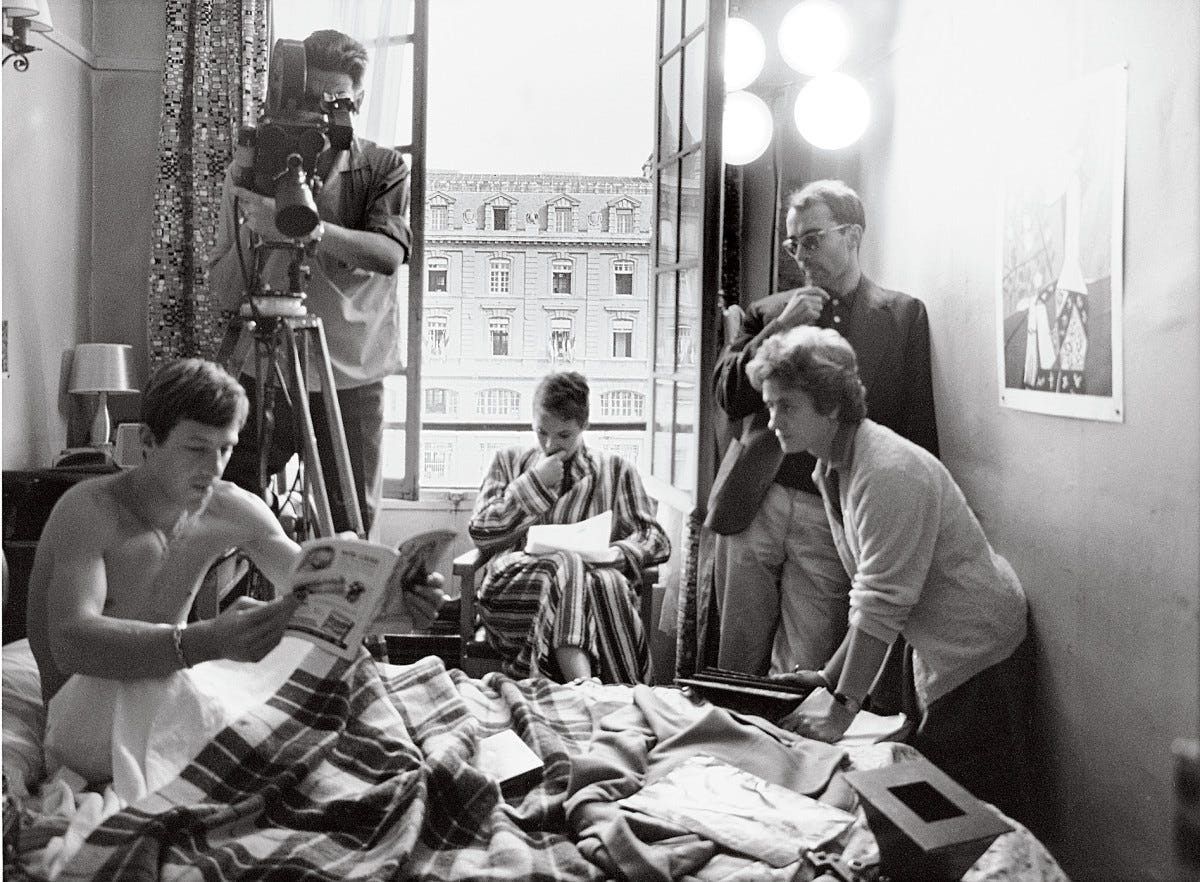
On the contrary, Nouvelle Vague is about beginnings. It is very telling of our times that Linklater is bringing both movies to the public in the same year. Something is ending, something else is beginning. Linklater doesn’t know what, but he feels it’s coming. Nouvelle Vague is looking at both the past and the future; it’s more than nostalgia for a cinema that once was new; it’s a joyful announcement that says: cinema will be new, again.
We cling to our old luggage because it's comforting. And the new world is frightening. I can't even bring myself to watch these movies. Caught Stealing looks terrible. I love the original High and Low too much to watch a bad new one. Honey Don't, looks silly, I guess I might break down and watch some day. But you sold me on Blue Moon!