


The first person I want to write about in connection with my film is an actor I never met in person and never directed, but is nevertheless part of the movie. After seeing his portrait as a thumbnail on Backstage, I googled “Joshua Pangborn” and immediately got pulled into his multiverse. Josh is a writer, actor, filmmaker, and the founder of SideKick Productions. When I contacted him, he was producing, directing, and acting in Skeleton Crew, The Art of Blowing It, and Demon Doctor1. He was also writing hilarious lines for all three, finishing a book, giving interviews as a Queer activist, pre-producing a musical, going to festivals with his short films, writing his first narrative feature, and managing the merch sale of everything previously mentioned. For someone as slow and ascetic as I am, he was simply mesmerizing. I felt I just met a Falstaff of a filmmaker, an American Fassbinder, someone who asked everything from life and more. Without knowing me or anything about my film project he immediately said yes to playing in one scene, and then there was a pause before he added that the only problem was… he did not have the time to go on set.
The scene in question consisted of him being some kind of underworld mobster called Wagner, giving an emotional monologue in front of the lead actor. My movie has nothing to do with mobsters or New York’s underworld, but I wanted this monologue to touch on something deep and horrific. It required a character who opens a door into the abyss which means great acting. When casting, the image I had in mind was Brando at the end of Apocalypse Now. And yet, the minute I saw Josh I knew it had to be him. Since my Brando could not come on set, I had to find a solution, and fast - we were filming in three days. I decided to add another character and gave Wagner a capo.
This capo would hold a cell phone, and the conversation between the lead actor and Wagner would happen through a video call, that way, Josh did not need to be physically present on set. I asked Josh if he could self-record the scene. He could play his lines however he wanted, I had no control over his performance. If this film is teaching me anything it is to relinquish control and with Josh it wasn’t hard, I trusted him. Josh said yes. He only had one question: what should be his background? I answered any background would do, as long as something moved slightly in the back. That piqued his curiosity: why should something move in the back? This is when I started telling him about Ozu.
Yasujirō Ozu is known for his distinctive use of static frames. His shots are carefully composed and immobile with characters often just talking to each other while seated. I have long been fascinated by Ozu’s use of static shots and wondered how he manages to create an image that is not lifeless although it’s composed of so many still elements. The obvious answer is that his use of deep layered perspectives keeps our eyes mobile. The frame is static but we can enjoy the beauty and complexity of its composition before the next frame pops up. I took this for granted until I watched Kogonada’s After Yang.
Kogonada is a fervent admirer of Ozu, so much so that his pseudonym is directly inspired by Ozu’s long-time screenwriter: Kogo Nada. I loved his first narrative feature, Columbus, and I am a fan of his video essays. In After Yang, Kogonada did not entirely film with static shots but he kept his camera’s movement to a minimum. Some scenes are filmed almost identically to the back-and-forth between actors typical of an Ozu movie. Other similarities included quiet acting and a layered background with deep perspectives. And yet, while Ozu’s movies vibrate as if they have a pulse, After Yang feels inert. The apparent similarity of cinematographical choices and the contrast with the actual result is striking. This made me rethink the role of the background in static shots. If background and acting are not what makes a static frame lively, then what is?
This wasn’t just a rhetorical question: my screenplay has many video calls and the challenge of making a static frame feel alive was significant. So I rewatched all of Ozu’s movies, sound off, one after another, practically the entire Criterion collection. And then it hit me. It’s not space that Ozu films, it’s the air inside the space.
Look carefully at the background in any of Ozu’s scenes but don’t stop at the intricacy of his compositions, the beauty of his colors, and the depth of his perspectives. There is, almost always, an imperceptible movement of the air. While we look at the shoji screens, there is also a window with a curtain. A soft breeze makes the curtain undulate imperceptibly. Or maybe it’s the laundry hanging on bamboo poles, or a rice paper lamp moving in the evening breeze, or even discarded magazines gently rustling on the ground.
Smoke is often used: it can be the swirling patterns of a cigarette’s smoke, incense burning, the white vapor of a tea kettle, factory smoke, train smoke… even the smoke from a dead man being incinerated. But Ozu’s ultimate magic wand to show us the air in the room, is a most beautiful object that he uses in an uncountable number of scenes: the fan.
A simple hand movement and the air moves, revealing the inner turmoil of a jealous wife…
… or contentment…
It can waive a deceased goodbye…
…or be a comical instrument of power.
But the fan’s first and most important function is to create a pulsation that visually animates the frame2. It is often thanks to the fan that Ozu’s image breathes. That, or the air that moves an object. This is how even when his camera, his decor, and his characters can be completely static, his image never is.
I learned to look hard at the background whenever one of my shots is static, making sure we can see the air in the room as Ozu did. I also told Josh exactly what I wrote here. And he got it, but he got it in a big way, in a Joshua Pangborn way. I won’t tell you what he did to animate the background of his self-recording, you will have to watch the movie, but it’s genius and hilarious.
On the morning of the shooting day, I received three files from Josh: three great takes. His acting performance was outstanding and he even left the blanks for our lead actor to say his lines. I transferred the best file on my phone and gave it to the actor who played Wagner’s capo - who turned out to be an actress but that’s for my next post. Here, this is a set photograph of Sarah holding Josh.
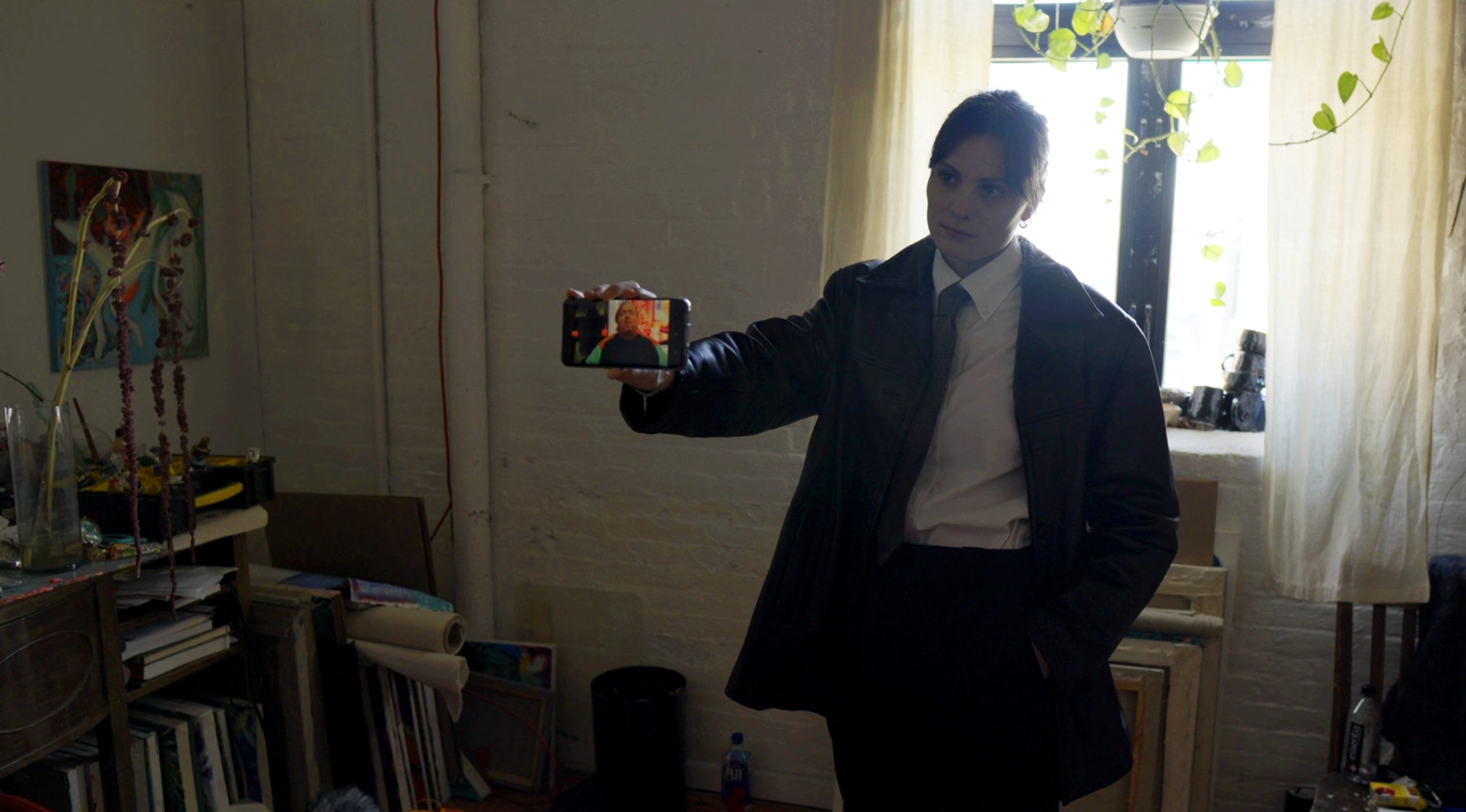
Something moves in Josh’s background and the window behind Sarah is open. The breeze makes the plant move gently too. The strange thing is that even if it came from a recorded monologue, Josh’s performance was so good that the emotion on set was palpable. I learned from another director, Aleksey German, that comic actors are the best at conveying poignant sadness3. And this is how filming an absent but talented actor turned into a beautiful way to start production.
Joshua’s work can be followed at the following links: TV series Skeleton Crew, Demon Doctor, and The Art of Blowing It. Instagram: @SideKickProductions and Demon Doctor. Twitter: @SideKickProd. Facebook: Joshua R. Pangborn and SideKick Productions.
I made a video essay on this.
Yuri Nikulin in Aleksey German’s Twenty Day Without War (1976).
Absolutely loved it! Thank you! Very insightful, inspiring and definitely makes me want to see the film (and watch again Ozu :). Keep filming and writing!