


Whenever I think about the film industry, this painting comes to my mind.
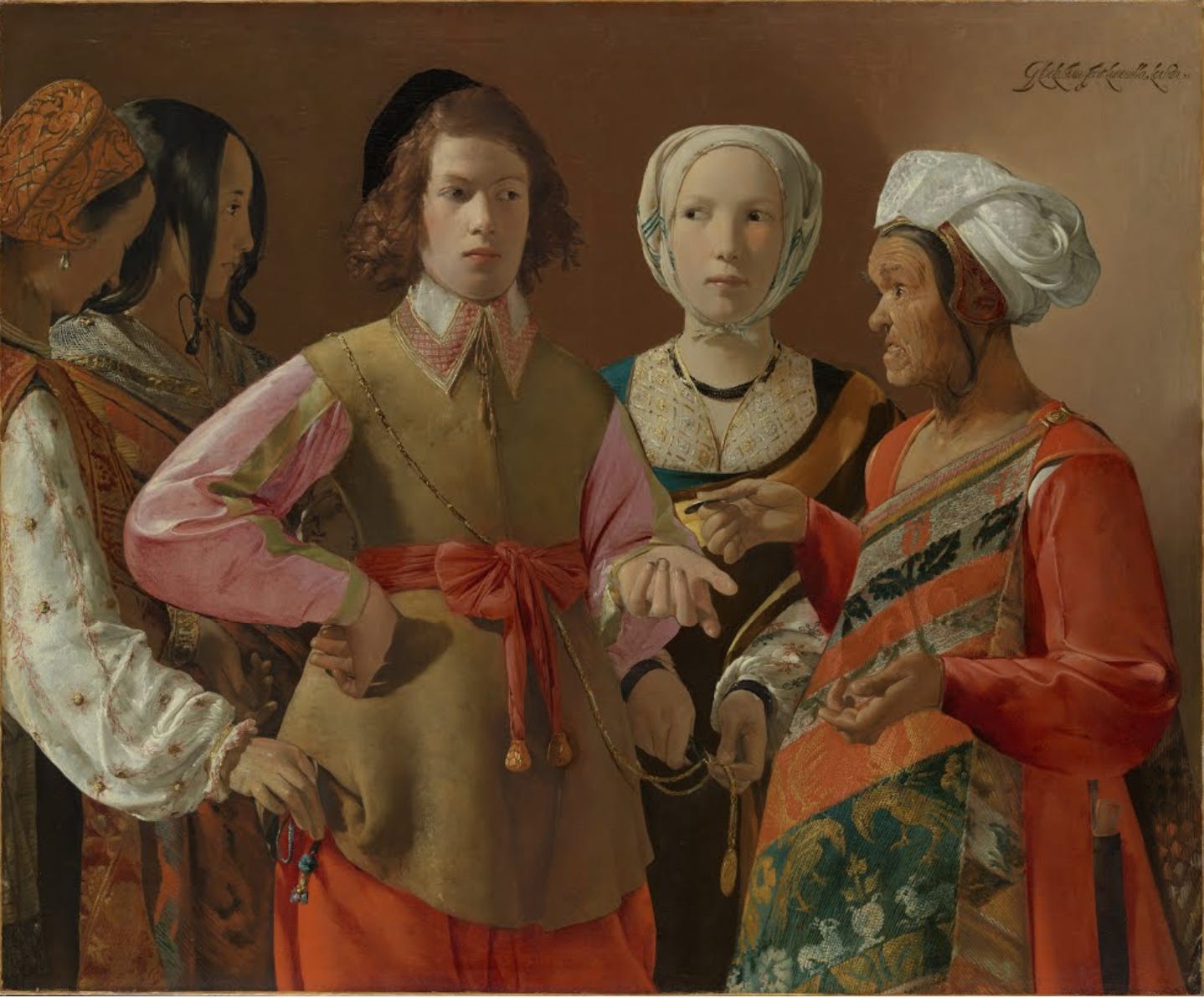
It’s The Fortune Teller by Georges de la Tour, but I retitled it A young filmmaker brings his first feature to the Market. I let you decide who is the sales agent, the festival programmer, the publicist, and the distributor. I taped it above my desk.
An earlier version of this text started with ‘there is no money left in the film business and it’s a good thing’. But looking again at de la Tour’s painting, I understood that there will always be some money left: the filmmakers’ own gold coin. Paradoxically, this is the root of the problem, and I’m not only talking about the mass of mediocre movies produced independently each year, because we can”.
Ted Hope candidly encourages filmmakers to take multiple jobs. He writes that “filmmaking is now a part-time gig,” but the tax definition of an activity that consistently loses money is not “gig”, it’s “hobby”. This last word deeply scares filmmakers, and that may explain why they crave professional workshops, networking events, and the array of services that festivals and film institutions sell them at prohibitive prices. Even if they don’t make money with their movies, filmmakers want to feel engaged in a profession. More than anything, they want to be part of it. But part of what exactly?
If you look closely, the ‘industry’ in ‘indie film industry’ mostly stands for selling services to filmmakers. And unless you can extract some worth from hearing that God helps those who help themselves, these services are useless. The system that existed and is now in disarray was too often working against filmmakers, even though they kept on paying for it.
Ted Hope, again, writes that film festivals “have been leading the little film lambs to slaughter for decades (…) and set all filmmakers up by not requiring filmmakers to know what they are in for when they get in. Agents and lawyers are motivated by the fee structure to get a deal done — even when it may not be in the film’s best interest at the time. The distributors want these newbies at the best price. Everyone is complicit, even if such evil is not their intent”. So why still go to pitch meetings for investors or producers who keep on ghosting you, attend wasteful labs, or submit movies to festivals that are no longer serving their core mission1? It seems that the young man in the painting agrees to lose his coin not for the tale he will hear but just to be among the fortune tellers. He is trying to fulfill an existential need.
As Hannah Arendt writes: “Everything that appears in public can be seen and heard by everybody and has the widest possible publicity. For us, appearance—something that is being seen and heard by others as well as by ourselves—constitutes reality. Compared with the reality which comes from being seen and heard, even the greatest forces of intimate life—the passions of the heart, the thoughts of the mind, the delights of the senses—lead an uncertain, shadowy kind of existence unless and until they are transformed, deprivatized and deindividualized, as it were, into a shape to fit them for public appearance. The most current of such transformations occurs in storytelling and generally in artistic transposition of individual experiences.”2
We want to be seen and heard by others as well as by ourselves. This is our drama, and the film business knows it.
The solution is not in rebuilding a now moribund industry. Those who try to ‘fix the system’ are also part of it, and it’s unlikely that they can change a thing. “Let’s rethink distribution,” they say, but people in the indie industry have been “rethinking distribution” forever. Indie films have always had a distribution problem. Unless it’s not a problem at all.
Perhaps solutions are not to be found at the level of distribution, and the only possibility of a change is at the source. It's the spirit that has to change, meaning our understanding of what movies are and how we create them. A new system will emerge if the ideas at the base of the creative act are new.
We could start by candidly admitting, as film producer Graham Swon did3, that making movies “is not a commercial endeavor. If you are thinking of it as one, I would urge you to stop. Your picture will almost definitely lose money, so presumably, you are doing it for other reasons.”4 It’s now a perfect time to explore and understand those other reasons. They can change the art form, the industry will follow as it always does, and who knows, maybe we’ll even make it a profession.
Although I disagree with some of his thoughts on branding (more on that in another post), I recommend Brian Newman's excellent newsletter.
Arendt, Hannah. The Human Condition, Second Edition, The University of Chicago Press, 1998, p.50.
This quote must be taken with a grain of salt as Graham Swon is now fully part of the industry and, according to his most recent interviews, looking forward to produce more commercial projects.
Advice for Producers on 12 Things to Be, Moviemaker, January 31, 2023.
These are the best advices I’ve read, notably the part where Swon points out that “The system that exists is inherently going to be working against you — the rental houses, the post-production labs, the publicists, the distributors, and all the rest. These institutions largely exist to make money, but as you’ll recall, you aren’t going to be making money. How can you protect yourself from them?”.
Let's not forget streaming services. Those are the real distribution deals these for indies days. I'd rather a film of mine go to MUBI than have some limited run at specific arthouses anyday. The audience is de-facto global and available 24/7 — not a bad deal.
Excellent post and good thoughts!